Vibe Testing: How AI is Changing The Way We Test
Vibe testing shifts product exploration and quality assurance to AI, letting it navigate, simulate user behavior, and identify edge cases automatically.

Vibe coding has been making waves across the software industry. But have you heard of the emerging trend called "vibe testing"?
Vibe coding allows developers to describe what they want in plain language and rely on AI to generate the code. In a similar spirit, vibe testing shifts product exploration and quality assurance to AI. Testers let it navigate the product, simulate user behavior, and identify edge cases automatically.
AI-powered quality assuranceWhat is Vibe Testing?
Vibe testing is a new AI testing approach where the AI generates, explores, executes, and maintains tests on its own.
Vibe testing becomes popular along with the rise of vibe coding and AI testing. Rather than following a predetermined set of actions, AI agents carry out tests, suggest improvements of their own accord, adapt tests to changing scenarios, and optimize their testing approach over time.
Instead of writing test scripts, describe what you want tested in plain language — and let AI handle the rest.
Key Characteristics of Vibe Testing
Key characteristics include:
You write what the user should experience rather than code how the test should run. Sometimes you don't even have to write prompts; the AI can just perform exploratory testing on its own.
The AI produces comprehensive test cases and updates them automatically as the product evolves.
Tests seek not just correctness but smoothness, clarity, and ease of use.
Tests automatically adjust when UI changes occur, reducing manual maintenance.
Vibe Testing vs. Traditional Testing
| Aspect | Traditional Testing | Vibe Testing |
|---|---|---|
| Who designs the tests | Humans write detailed test cases and scripts | AI generates and decides how to test |
| How tests are created | Manual scripting (Selenium, Playwright, etc.) | Natural language prompts → AI handles execution |
| Testing style | Structured, predefined scenarios | Autonomous exploration |
| Coverage model | Systematic and planned | Dynamic and AI-discovered |
| Maintenance | Humans update broken tests | AI self-heals and adapts |
| Consistency | Deterministic (same every run) | Can vary depending on AI behavior |
| Speed | Slower setup, predictable runs | Fast setup, rapid iteration |
| Human involvement | High | Low to moderate (oversight role) |
| Best for | Critical systems, compliance, backend logic | Rapid UI testing, MVPs, fast-moving products |
Advantages and Disadvantages of Vibe Testing
Advantages
- Easy to create tests using plain English (no heavy coding required)
- Faster test creation and iteration
- Lower maintenance due to self-healing capabilities
- Accessible for non-technical team members (PMs, QA, founders)
- Speeds up MVP validation and rapid releases
- Encourages collaboration between product and engineering
Disadvantages
- May lack precision for highly complex logic or edge cases
- Over-reliance on AI can reduce deep technical understanding
- Debugging AI-generated tests can sometimes be unclear
- Less control compared to fully coded automation frameworks
- May struggle with highly dynamic or custom UI components
- Pricing can scale quickly with usage
“Vibe testing lets us focus on what matters — finding real user issues — instead of maintaining brittle test scripts.”
Best Practices for Vibe Testing
-
Define clear outcomes — Before you start vibe testing, make sure to define clear outcomes (what success and failure mean).
-
Divide and conquer — Let your vibe testing tool explore the common test cases while you focus on the edge cases and unusual user behavior.
-
Combine approaches — Combine directed testing (specific flows) with open exploration.
-
Review AI findings — Always review AI findings. Don't blindly trust results.
-
Start early — Use vibe testing early in the product lifecycle (MVP stage).
The best teams use vibe testing for rapid validation, then selectively harden critical paths into traditional automated tests for compliance and regression safety.
Best Vibe Testing Tools of 2026
1. ScoutQA
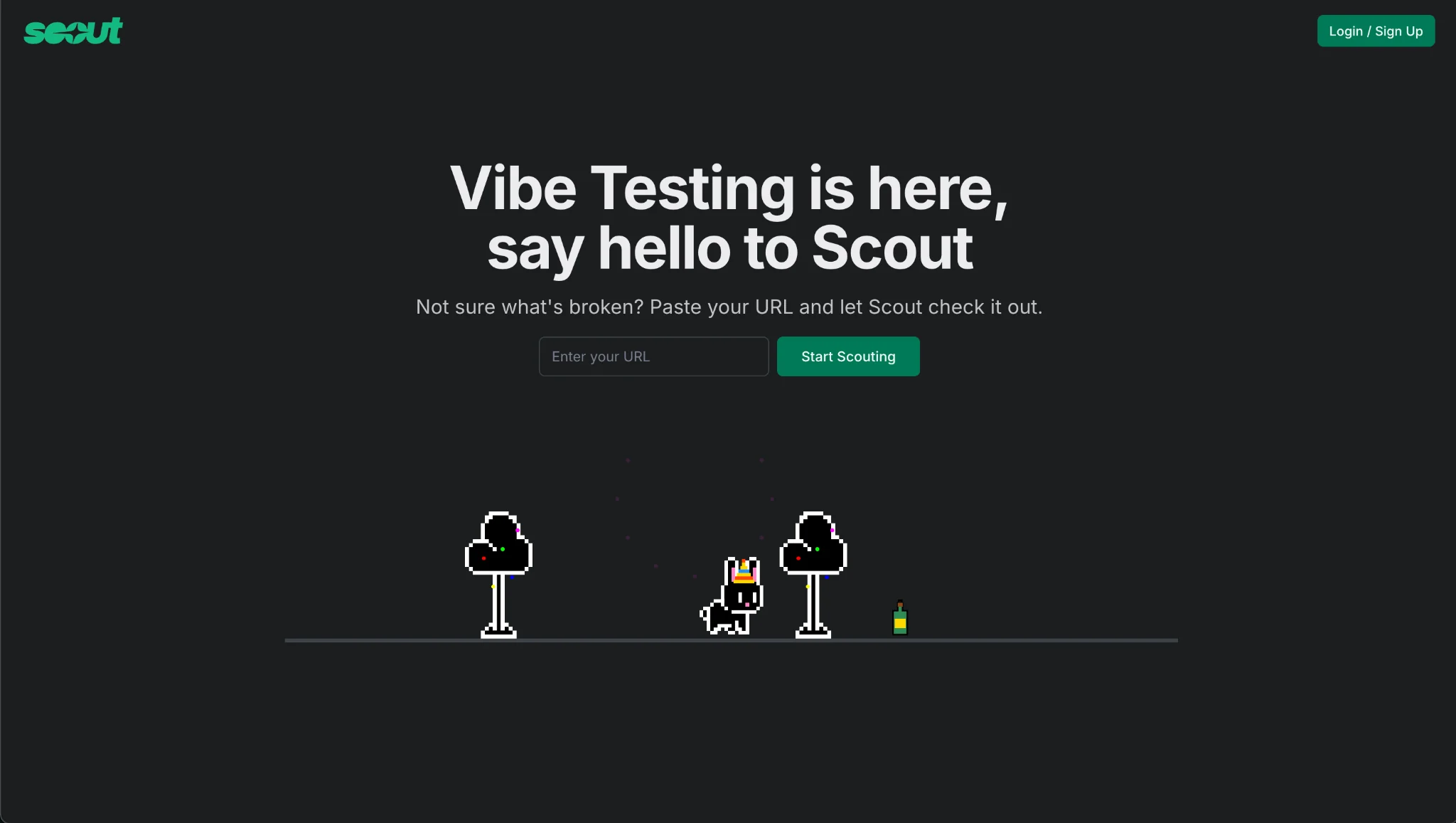
ScoutQA is a true vibe testing tool. You don't have to manually write test cases; you let AI explore, validate, and report everything autonomously.
Simply enter the URL of the web application you want to start and hit "Start Scouting". Right away, ScoutQA starts navigating around like a real user and:
- Clicks through flows and branches
- Tries unexpected combinations
- Identifies friction points
- Detects functional and UX issues
- Generates structured bug reports
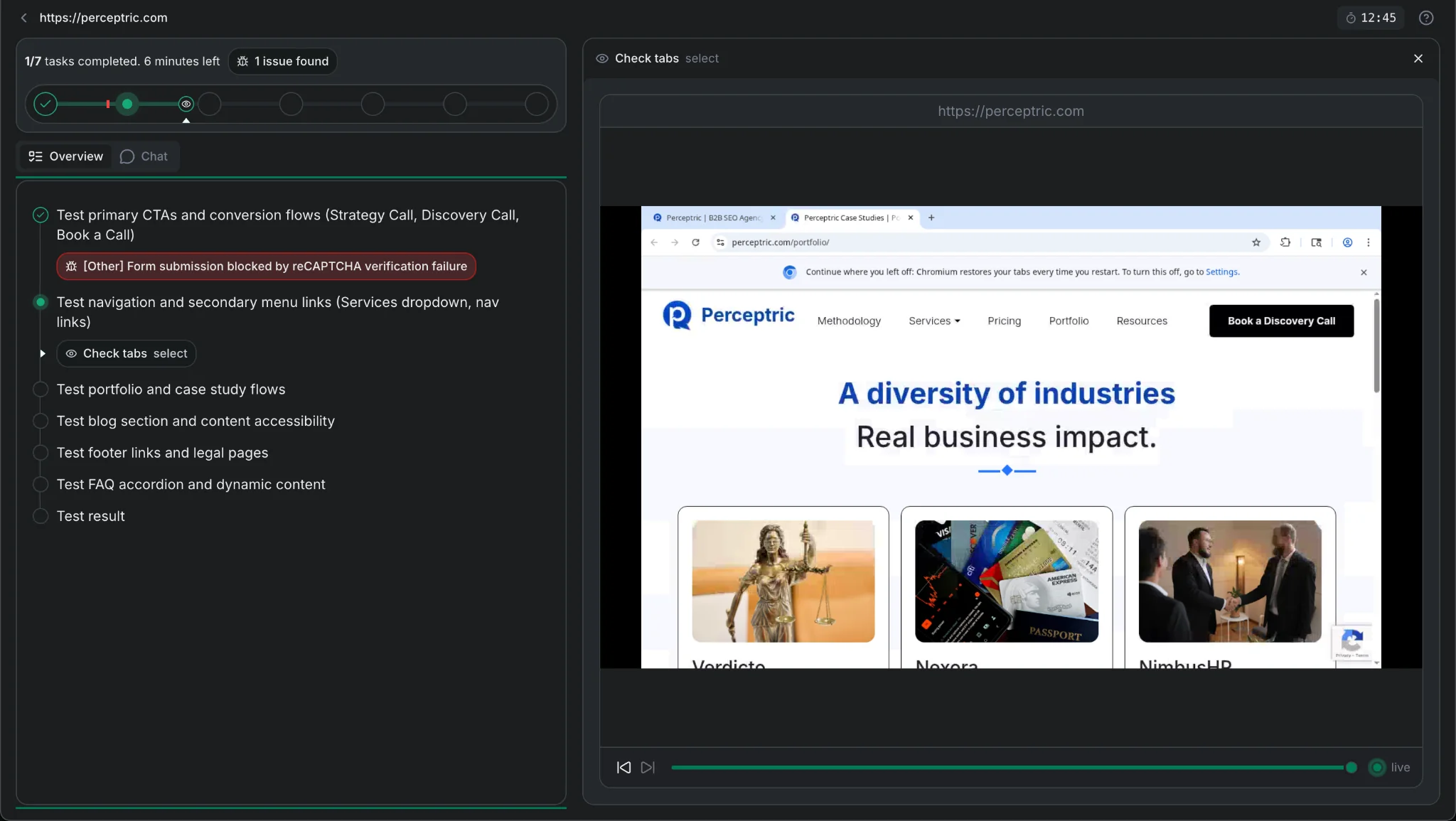
Unlike traditional tools, ScoutQA doesn't need scripts or selectors. Just a URL and intent — and the AI explores like a real user.
2. Momentic AI
Momentic AI is an AI-powered end-to-end testing platform designed to help software teams automate UI testing. In a way, that makes it a great vibe testing tool. It enables product and engineering teams to create, maintain, and scale reliable tests quickly.
Key features:
- Natural language test creation (write tests in plain English instead of code)
- Self-healing tests that adapt to UI changes automatically
- AI-powered element detection that understands context, not just selectors
- Cross-browser testing support
- CI/CD integration for automated test runs on deployment
- Visual debugging and detailed test reports
- Parallel test execution to speed up feedback loops
- Collaboration features for product, QA, and engineering teams
Pricing: Custom pricing based on team size, usage, and testing volume.
3. TestRigor
testRigor is an AI-driven test automation platform designed to help QA and engineering teams create stable end-to-end tests using plain English.
Key features:
- Create tests in plain English (no programming required)
- AI-powered self-healing tests that adapt to UI changes
- Cross-browser and cross-platform testing (web, mobile, desktop)
- Built-in test case generation from manual test steps
- CI/CD integration for automated test execution
Pricing: Tiered pricing based on number of test runs, users, and environments.
Conclusion
Vibe testing is a new and fascinating trend in the testing world, and it's worth exploring to see how it fits into your testing strategies.
The shift from traditional testing to vibe testing represents more than just a technology change — it's a mindset shift. Instead of trying to predict every user path and write exhaustive test scripts, vibe testing embraces the complexity and unpredictability of real user behavior. AI becomes your testing partner, exploring the application in ways you might never have imagined.
Whether you're a startup trying to move fast or an established team looking to reduce maintenance overhead, vibe testing offers a compelling alternative to traditional approaches. The key is finding the right balance — using AI for broad exploration while maintaining human oversight for critical decisions.
The future of testing is here — and it's powered by AI.Want to vibe-test right away? Try ScoutQA: https://scoutqa.ai/